
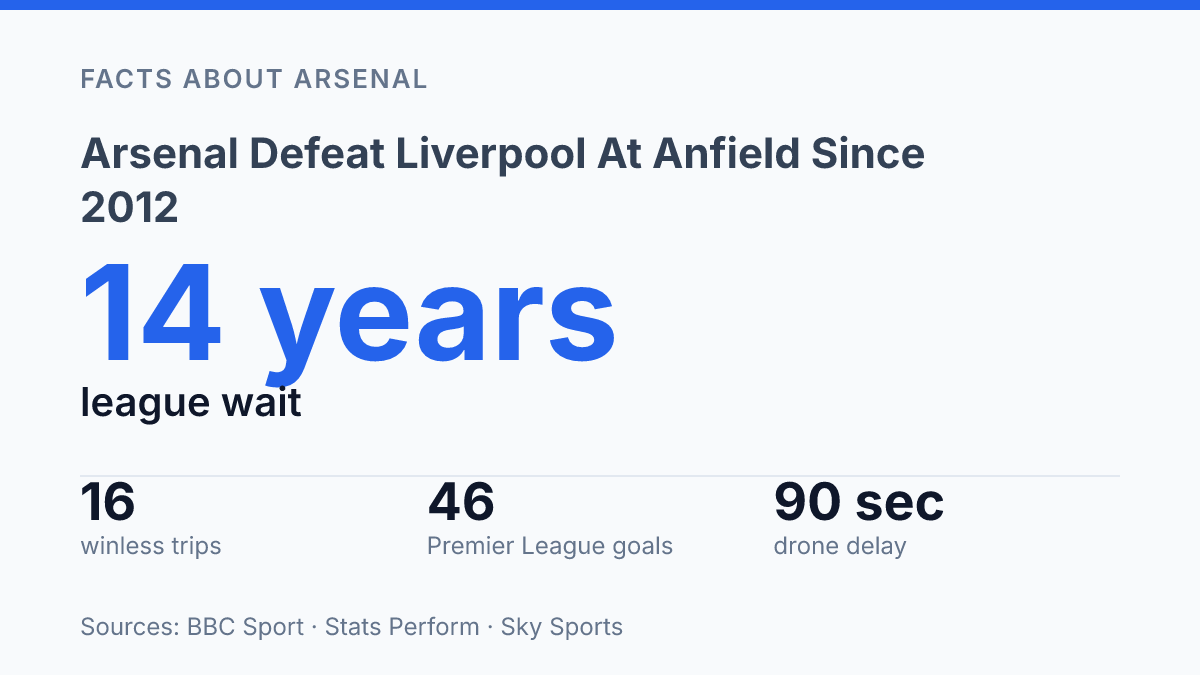
The phrase “Arsenal Defeat Liverpool At Anfield Since 2012” points to a 1-0 result on 1 November 2026 that ended 13 winless Premier League visits and a broader run of 16 unsuccessful trips to Liverpool in all competitions. Arsenal’s previous league victory there had come on 2 September 2012, a gap long enough to span managers, title cycles, and several heavy defeats. The decisive moment arrived early, when Kai Havertz scored in the 16th minute, yet the match was defined as much by what Liverpool could not do: 17 shots produced no effort on target, an unprecedented Anfield home league blank in Premier League shot-on-target records dating to 2003-04.
The result also landed four days after Arsenal’s penalty loss at Fleetwood in the Carabao Cup, giving the performance a sharper edge. The article examines why the win carried historical, tactical, and title-race weight.
How Arsenal ended a 14-year league wait at Anfield
A fixture that had resisted Arsenal for 16 visits turned on one first-half finish rather than a display of territorial command. The 1-0 victory at Anfield was historic because it ended a long sequence of frustration in a ground where Arsenal had repeatedly failed to convert strong teams, promising spells, or title ambitions into a league win.
Arsenal’s breakthrough came through Kai Havertz, whose first-half goal supplied the decisive margin. The narrow scoreline matters to the meaning of the result: this was not a win built on prolonged attacking superiority, but on taking a chance early enough to alter the match and then defending the advantage with discipline. That pattern made the outcome feel less like a routine away victory and more like the removal of a psychological and competitive barrier.
The historical weight was clear in the timeline. Arsenal’s 1-0 win on 1 November 2026 ended a 14-year league wait at Anfield, with their previous league victory there coming in a 2-0 win on 2 September 2012, according to BBC Sport via AOL. That gap explains why the result carried significance beyond three points: Anfield had become one of the clearest measures of Arsenal’s progress under pressure.
Mikel Arteta’s connection sharpened the story because he was Arsenal’s captain on the day of that 2012 win. Returning as manager to end the wait gave the result a symmetry that was unusual but not merely sentimental. It linked the last successful Arsenal side at Anfield with the current one, while showing how long the club had gone without repeating that standard in a league match there.
Arteta’s pre-match message, “Today has to be the day,” framed the win as a test of timing as much as quality. Arsenal met that demand through a single decisive action and a collective refusal to let the match drift away after it. For a club measuring itself against title-level standards, the importance lay in winning at a venue where good performances had too often left with too little.
Why the Fleetwood Cup loss mattered before kickoff
Four days before a statement win at Anfield, Arsenal had been removed from the Carabao Cup by a side sitting in the fourth tier. The defeat to League Two Fleetwood Town on Tuesday was embarrassing because of both the opposition and the context: according to Sky Sports, the tie finished 1-1 before Fleetwood won 5-3 on penalties, despite Arsenal starting senior forwards and calling on Martin Odegaard from the bench. That made the result difficult to dismiss as a routine rotation-related cup setback.
Mikel Arteta did not present the Fleetwood loss as irrelevant after the Liverpool match. His framing was more specific: a damaging result had created the conditions for a response, not guaranteed one.
He said he was “extremely proud” of the performance that followed and pointed to “the spirit we’ve shown,” especially after going out of a competition against “a team you are supposed to beat.” In his words, football “can take you to really bad places but four days later you have the opportunity to do something really historic.”
That distinction matters because cup defeats can unsettle teams in different ways. A poor midweek result may raise questions about concentration, squad depth, or emotional control, particularly when the next assignment is one of the hardest away fixtures in English football.
Arteta’s argument was not that the Fleetwood defeat helped in any simple or automatic sense, but that Arsenal used the short turnaround to reset their competitive level. The Anfield performance therefore carried an added layer: it was not only a response to a long-running away record, but also to an immediate setback that could have deepened pressure before kickoff.
How Arsenal protected the lead under pressure
Liverpool’s first-half pressure was measurable as well as visible: according to Stats Perform via FotMob, they had 28 touches in Arsenal’s box before the interval, the most by any side in the opening half of a Premier League match against Arsenal since records began in 2008-09. That figure explains why the away side’s protection of the lead became the defining tactical story after the early advantage. Arsenal were not simply managing territory; they were being forced deeper by repeated Liverpool entries and had to defend long spells without allowing those attacks to become clear, accurate attempts on goal.
Gabriel had anticipated that kind of match before kickoff, warning that Arsenal expected a “big battle” and “big chaos” at Anfield. The description proved accurate once Liverpool raised the tempo before half-time and pinned Arsenal back for sustained periods. A defensive display in that kind of state can look passive from the outside, but the purpose was clear: reduce central danger, survive the moments when Anfield momentum built, and make Liverpool’s pressure take place in areas where it did not translate into a decisive finish.
The clearest evidence of that control was the final shot profile. Liverpool finished with 17 shots and 0 on target, and Stats Perform via FotMob reported that this was the first time they had failed to register a shot on target in a home Premier League match since such records began in 2003-04, across 442 league games at Anfield in that period.
Arsenal’s clean sheet therefore was not just a product of poor Liverpool finishing; it reflected the way pressure was absorbed without allowing the hosts to test the goalkeeper. The second half was less frantic, but the same defensive discipline carried through, turning a narrow lead into a result built as much on restriction as resistance.
What the result changed in the title race
The win did not settle a title race after nine matches, but it turned Arsenal’s strong start into a measurable lead: 24 points, three clear at the top, according to BBC Sport via AOL. That matters because the result converted a difficult away fixture into table separation rather than merely preserving position. It also gave Arsenal a direct points swing from a match against one of the sides closest to them at the start of the day, without requiring any broader conclusions about May.
Defensive consistency was the clearest repeatable element behind that position. Arsenal’s six clean sheets this season show that the Anfield performance was part of a wider pattern rather than an isolated act of resistance. Clean sheets do not explain every part of a title challenge, but they reduce the number of matches that need to be won through high-scoring attacking output, which is especially relevant in tight away games.
Mikel Arteta framed the result less as a statement of superiority than as evidence of the standards required from a side trying to win consistently. His assessment that beating “a team that is producing what they are doing” was “what a winning team should do” placed the emphasis on response, control, and execution under pressure. The significance of that comment lies in its restraint: it did not claim a finished product, but it identified the kind of away result that separates a good start from a more durable one.
Nine league matches remain a short sample, so the table lead is best read as an early marker rather than proof of an outcome. What changed was the quality of the evidence behind Arsenal’s position. They were no longer simply top after routine accumulation; they had added a high-pressure away win, another clean sheet, and a stronger margin at the summit to the record.
What the win asks of Arsenal next
One Anfield win cannot settle a title race in November, but it can change the standard by which Arsenal are judged. The value of the result lies less in the break with 2012 than in the type of away performance it now requires them to reproduce: scoring first, defending without clean statistical comfort, and leaving a direct rival with fewer answers than their pressure suggested.
The Fleetwood defeat showed how fragile perception can be over four days; Anfield showed how quickly it can be repaired at the highest level. If Arsenal’s challenge is to mature from contender to champion, this match becomes useful only if it stops being exceptional.
Frequently Asked Questions
Q: When was Arsenal’s last league win at Anfield before this result?
A: Arsenal’s previous Premier League win at Anfield came in 2012, when they won 2-0. Mikel Arteta was the Arsenal captain in that match. This latest victory ended a 14-year wait for a league win at Liverpool.
Q: How many times had Arsenal failed to win at Liverpool before this match?
A: Arsenal had gone 16 away games without a win in all competitions against Liverpool before this victory. That run underlines how difficult Anfield has been for them in recent seasons. The result therefore carried both league and symbolic importance.
Q: Who scored Arsenal’s goal against Liverpool?
A: Kai Havertz scored the first-half goal that decided the match. It was enough to secure Arsenal’s first Premier League win at Anfield in 14 years. The goal also reflected a game plan built around taking an early lead and then defending it.
Q: Why was Arsenal’s win at Anfield considered significant?
A: The win came after Arsenal had lost to League Two Fleetwood Town in the Carabao Cup only four days earlier. Beating Liverpool in that context made the result more notable because it showed a strong response to a setback. It also came against a side that had been producing strong performances at home.
Q: How did Arsenal manage to beat Liverpool away from home?
A: Arsenal relied on disciplined defending and limited Liverpool’s chances after taking the lead. Liverpool did not register a shot on target, even though they applied pressure for long spells. That resilience helped Arsenal preserve a rare clean-sheet victory at Anfield.