
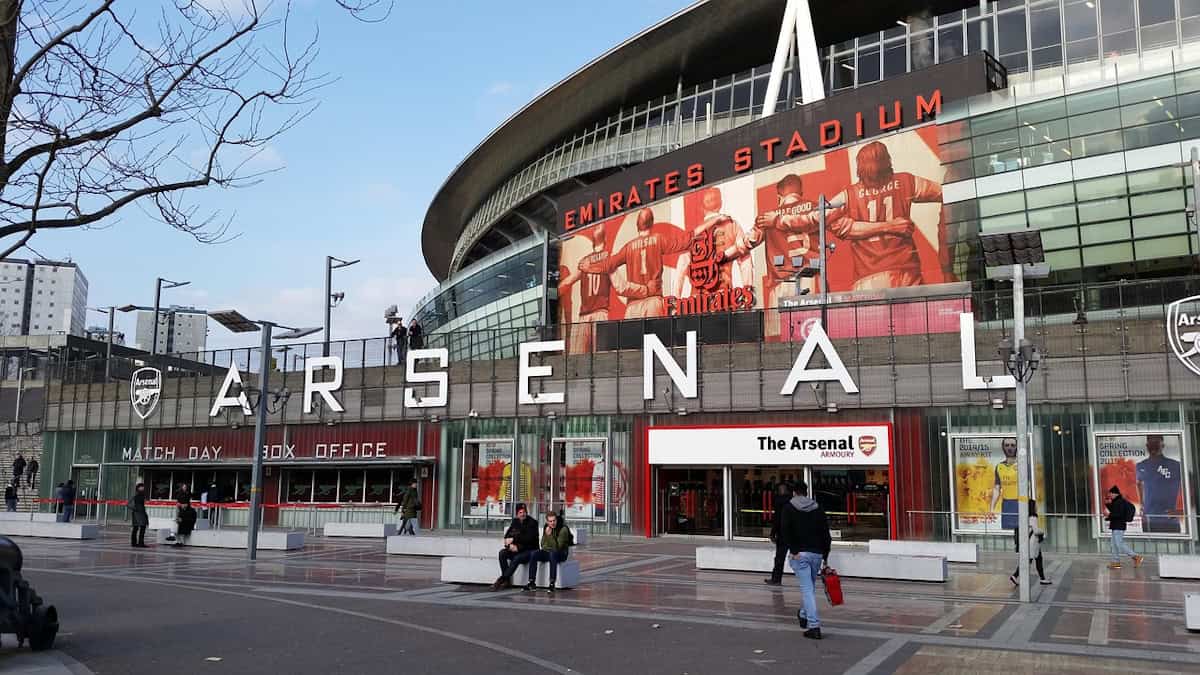
Arsenal have played at two genuinely significant grounds. One that shaped the club’s identity for nearly a century, and one that was built specifically to replace it. The gap between them isn’t just architectural. It’s the distance between a ground that grew with a club and a stadium that was designed to outgrow it.
Most stadium articles list the capacity and move on. The more interesting facts are the ones that explain why the move happened when it did, what it cost, what was lost, and what the Emirates has become in the nearly two decades since it opened.
In my honest opinion, you don’t fully understand Arsenal as a modern club until you understand both grounds — not as separate chapters, but as a single argument about what kind of institution Arsenal wanted to be.
Emirates Stadium: the essential facts
The Emirates Stadium opened in July 2006, replacing Highbury as Arsenal’s home after 93 years. It sits on Ashburton Grove in Holloway, Islington. Less than 500 metres from the old Highbury ground, close enough that supporters walking between them pass through the same streets.
The capacity is 60,704, making it the second-largest club ground in English football behind Manchester United’s Old Trafford. Every seat is covered. The pitch dimensions are 105 metres by 68 metres. Standard for top-level European competition.
The naming rights were sold to Emirates airline before the ground opened, in a deal that helped service the construction debt. The arrangement runs long-term; the stadium’s official name has been the Emirates since day one.
The first competitive match at the ground was played on August 19, 2006, a 1–1 draw against Aston Villa in the Premier League. Gilberto Silva scored Arsenal’s first competitive goal there. In my view, that result was quietly fitting: a stadium built to project ambition, opening with a draw, suggesting the journey from Highbury to the top of European football was going to take longer than the architects’ drawings implied.
Highbury: what it was and what happened to it
Arsenal moved to Highbury in 1913 and stayed for 93 years. In that time the ground became one of English football’s most distinctive venues. Not because of its size, but because of its character. The art deco East Stand, completed in 1936, was given Grade II listed status by English Heritage; it’s now one of the most architecturally significant football stands in the country.
For a full overview of Arsenal’s home ground across both eras, the club’s wider history gives the context that explains why Highbury meant what it did — and why leaving it was genuinely complicated rather than just commercially obvious.
Highbury’s final capacity was around 38,419. By the standards of the Premier League era, that was too small; the club was routinely turning away demand it couldn’t accommodate. The last match there was a 4–2 win over Wigan Athletic on May 7, 2006, with Thierry Henry scoring the final goal in the 76th minute.
The ground didn’t sit empty after Arsenal left. It was converted into a residential development called Highbury Square. The pitch area became a private garden, the listed East and West stands were retained as apartment facades, and the North Bank and Clock End were demolished and rebuilt as housing. The project was completed around 2010. In my humble opinion, that outcome is a better fate than most old grounds get; the architecture survived, even if the atmosphere didn’t.
How the Emirates was financed and built
The Emirates Stadium cost approximately £390 million to build — a figure that made it one of the most expensive sports venues constructed in England at the time. Arsenal funded it primarily through debt, taking on loans that the club spent the better part of a decade repaying.
The site had its own complications. Ashburton Grove was a waste transfer station before construction began; clearing and preparing the land added both time and cost to the project. The planning process ran for years, with local consultation, council negotiations, and multiple redesigns before the first foundations went in.
Construction started in 2004 and took roughly two years. The bowl design was chosen specifically for sightlines and acoustics — every seat has a direct view of the pitch, with no supporting pillars obstructing the view. The roof covers all 60,704 seats without a single seat left exposed.
The naming rights deal with Emirates airline was structured to help manage the debt. It wasn’t the first time an English club had sold stadium naming rights, but it was one of the higher-profile deals of its era; the airline’s name is now inseparable from the ground in a way that would have been unusual twenty years earlier.
Matchday at the Emirates: attendance, atmosphere, and what the numbers show
In 2024/25, Arsenal averaged 60,251 supporters across 19 home Premier League matches, according to worldfootball.net. That is within 500 of the stadium’s maximum capacity, week after week across a full season.
The waitlist for season tickets has been running for years. Demand consistently exceeds what the Emirates can accommodate — the same problem Highbury had, at a scale that would have been unimaginable in 1913.
Atmosphere is the more contested question. The Emirates is a modern bowl stadium. Wide, deep, and designed to maximise the number of seats rather than the noise they generate. Supporters who watched at Highbury regularly note the difference; the old ground’s narrow design meant crowd noise had nowhere to go but forward onto the pitch. The Emirates disperses it.
That criticism has softened in recent years. As the team under Mikel Arteta has pushed for title contention, the atmosphere on European nights and in decisive league matches has shifted noticeably. A stadium doesn’t change; the team and the moment change what the crowd does inside it. In my honest opinion, the Emirates at full noise is a genuinely intimidating venue — it just requires a match worth responding to.
What the two grounds tell you about the same club
Highbury lasted 93 years and shaped every generation of Arsenal supporters who passed through it. The Emirates has been open for less than 20. By the time it reaches the age Highbury was when Arsenal left, it will have hosted things nobody can predict yet.
The facts that matter most aren’t the dimensions or the capacity figures. They’re the decisions behind both grounds: a 1913 relocation driven by financial survival, and a 2006 construction driven by financial ambition. Different pressures, same underlying logic. Arsenal needing a bigger platform to compete at the level it believed it belonged.
In my view, both grounds are expressions of the same club at different stages of the same argument. Highbury said Arsenal were serious. The Emirates said they intended to stay that way.
Frequently Asked Questions
What is Arsenal’s current stadium?
Arsenal’s current home is the Emirates Stadium, located on Ashburton Grove in Holloway, north London. It opened in 2006 with a capacity of 60,704 and replaced Highbury, which had been the club’s ground since 1913. The stadium is named after Emirates airline, which holds the naming rights.
In my honest opinion, the location, less than 500 metres from the old Highbury ground — is an underappreciated detail; the club moved without really leaving the neighbourhood.
How big is Arsenal’s Emirates Stadium?
The Emirates Stadium holds 60,704 spectators, making it the second-largest club ground in England after Old Trafford. Every seat is covered and has a clear sightline to the pitch. The playing surface is 105 metres by 68 metres, which meets UEFA requirements for European competition. In the 2024/25 Premier League season, Arsenal averaged 60,251 fans per home match — close to a full house every weekend.
What happened to Arsenal’s old ground, Highbury?
Highbury was converted into a residential development called Highbury Square after Arsenal moved to the Emirates in 2006. The listed art deco East and West stands were retained as the facades of apartment buildings, and the old pitch area became a communal garden. The North Bank and Clock End terraces were demolished and replaced with new housing. The project completed around 2010. In my view, it’s one of the better outcomes for a disused football ground — the architecture survived in a usable form rather than being demolished entirely.
How much did the Emirates Stadium cost to build?
The Emirates Stadium cost approximately £390 million to construct. Arsenal financed it primarily through debt, which the club spent several years repaying after the ground opened. The naming rights deal with Emirates airline was part of the financial structure designed to service that debt. Construction began in 2004 on a site previously used as a waste transfer station and took approximately two years to complete.
Is Highbury’s East Stand still standing?
Yes. Highbury’s art deco East Stand, completed in 1936, was given Grade II listed status by English Heritage and could not be demolished. It now forms the exterior facade of a block of apartments as part of the Highbury Square development. The stand’s distinctive architecture — considered one of the finest examples of art deco design in English football — is intact, though its interior no longer resembles a football stand in any way. In my humble opinion, seeing it from the street is a slightly strange experience; a football landmark that now belongs entirely to a different world.