
Arsenal’s well-known story; the factory workers, the Invincibles, the Highbury farewell… gets told often enough that the less visible parts of the club’s history get crowded out. Behind the headline facts sits a collection of details that are genuinely surprising, occasionally strange, and consistently revealing about how this particular club developed over 140 years.
These aren’t trivia questions designed to catch people out. They’re the facts that add texture to the story most people already know. The specific details that, once you know them, make everything else about Arsenal make slightly more sense.
In my honest opinion, the best club history isn’t in the trophies. It’s in the odd, human, specific things that don’t fit neatly into a highlights reel.
1) Arsenal wore red because of Nottingham Forest
Arsenal’s red kit is so embedded in the club’s identity that the idea of them wearing anything else seems impossible. But the original Dial Square team in 1886 had no kit at all, the founding players wore whatever they brought from home, in a mix of colours that looked less like a football team and more like a group of workers who’d agreed to meet on a pitch.
The red shirts came from Nottingham Forest. A former Forest player named Fred Beardsley had moved to Woolwich for work and joined the new club; he contacted Forest and they donated a set of their red shirts and a ball to get Arsenal properly kitted out. The colour stuck.
There is something quietly fitting about this. One of the most recognizable kits in world football, the specific red that sponsors pay millions to be associated with, began as a charitable donation from a Midlands club to a group of south London factory workers who couldn’t afford their own strip. In my honest opinion, that origin is more interesting than any deliberate branding decision could be.
2) Arsenal were controversially promoted without being elected
 Arsenal’s continuous top-flight record, unbroken since 1919, the longest current run in English football — has a complicated starting point. In 1913, the club were relegated to the Second Division. When league football resumed after the First World War in 1919, the First Division was expanded from 20 to 22 clubs.
Traditionally, the two clubs with the best Second Division records would be promoted. Instead, Henry Norris, the same chairman who had relocated the club to Highbury lobbied successfully to have Arsenal included in the expanded First Division ahead of Tottenham Hotspur, who had actually finished higher in the Second Division that season.
The exact nature of that lobbying has never been fully documented. What is documented is the outcome: Arsenal were voted into the First Division; Spurs were not. It remains one of the more controversial administrative decisions in English football history, and Tottenham supporters have not forgotten it.
Arsenal have not been relegated since. That is a 107-year unbroken run in the top flight. A record that, however it began, has been earned over a century of sustained competition. In my view, the 1919 controversy is part of the club’s history rather than a mark against it; what Norris did was sharp, not illegal, and the club built something real on the platform it created.
3) Herbert Chapman invented the numbered shirt and much else besides
Herbert Chapman managed Arsenal from 1925 to 1934 and was arguably the most innovative football manager England has ever produced. The list of things he introduced or popularised reads like a history of the modern game compressed into one man’s career. 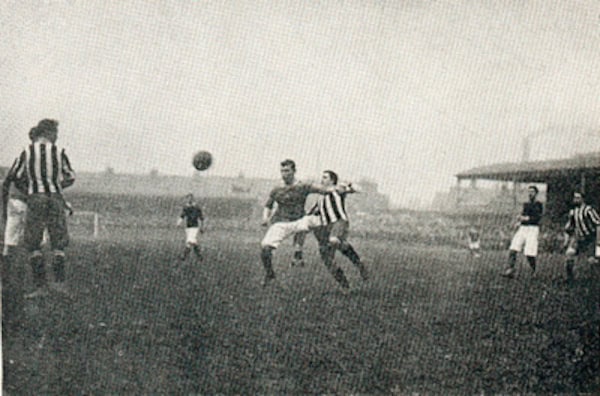
Chapman was the first manager to push for numbered shirts on players. Arsenal and Chelsea wore numbered shirts in a First Division match in 1928, the first time it had been done. He advocated for floodlit matches, for white sleeves on the Arsenal shirt to make players more visible in bad light, for the use of a clock at a ground (which became the famous Highbury clock), and for the construction of the underground station that would eventually be renamed Arsenal in the club’s honour — the only London Underground station named after a football club.
Tactically, he refined the WM formation that redefined how English football was structured in the 1930s. Administratively, he pushed Arsenal to become a genuinely professional operation at a time when most clubs were still run as extended amateur enterprises.
Chapman died suddenly in January 1934 of pneumonia, mid-season, at the height of his powers. Arsenal won the title that season and the next two, a testament to the structures he had built that outlasted him. In my humble opinion, Chapman belongs in any serious conversation about the most important figures in English football history, not just Arsenal’s.
4) The Emirates Underground station is named after the club
Arsenal is the only Football League club to have a London Underground station named after it. The station, on the Piccadilly line between Holloway Road and Finsbury Park, was renamed Arsenal in 1932. Changed from Gillespie Road at the request of Herbert Chapman, who argued the existing name was confusing for supporters trying to reach Highbury. 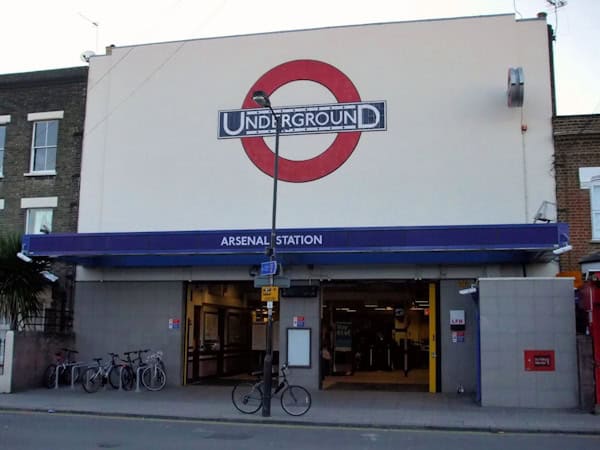
London Underground agreed. The station has been Arsenal ever since, including through the move from Highbury to the Emirates in 2006. Geographically, it now sits closer to the old Highbury site than to the current ground, but the name has never been reconsidered.
It is a small thing in isolation. In context, it is a measure of how completely Arsenal embedded itself in north London’s infrastructure during the Chapman era. A club that had been a south London factory team in 1886 had, by 1932, put its name on the city’s public transport network. That trajectory is genuinely remarkable, even if most people who use the station on a non-matchday don’t think twice about it.
5) The Invincibles’ unbeaten run was ended by Manchester United
Arsenal’s 49-game unbeaten league run, spanning the entire 2003-04 season and the opening months of 2004-05 was ended on October 24, 2004, by Manchester United at Old Trafford. United won 2–0. Ruud van Nistelrooy scored a penalty; Wayne Rooney added the second.
The manner of the defeat became as famous as the defeat itself. A tunnel confrontation after the final whistle, involving multiple players from both sides, resulted in several FA charges. Arsène Wenger received a touchline ban. The post-match atmosphere was more charged than most actual matches… which, given how much Arsenal and United disliked each other during that period, is saying something.
Arsenal were publicly measured about the loss at the time; Wenger acknowledged the run had to end eventually. In my honest opinion, the United game ending it was appropriate in a specific way. The two clubs were at their most intense rivalry during exactly that period, and losing to United after 49 unbeaten games is a more interesting historical footnote than losing to anyone else would have been.
6) Arsenal’s nickname came from an actual armaments factory
Most football nicknames are approximate or invented. Colours turned into metaphors, local animals pressed into service as symbols. Arsenal’s is entirely literal. The Gunners nickname derives directly from the Royal Arsenal armaments factory in Woolwich where the club was founded in 1886; the cannon on the badge is a direct representation of what the founding workers manufactured.
For a broader look at how that origin connects to the club’s present identity, the bigger picture on Arsenal sets the full context — from factory floor to Emirates Stadium and everything that happened in between.
What makes this notable is the durability. Arsenal left Woolwich in 1913. The armaments industry that defined Woolwich in the Victorian era has no presence in north London. The founding workers have been gone for generations. And yet the cannon is still on the badge, the Gunners is still the nickname, and the Arsenal Underground station still uses the name the same chairman gave it in 1932. Most clubs that move grounds lose their original identity gradually. Arsenal kept it specifically.
7) Arsène Wenger changed what Premier League players ate
When Arsène Wenger arrived at Arsenal in 1996, he found a squad whose pre-match preparation included things that would be considered extraordinary by modern standards. Alcohol on certain occasions, diet largely unmanaged, recovery methods that reflected 1980s thinking rather than contemporary sports science.
Wenger introduced dietary protocols that were standard in French football but alien in England: specific nutritional guidelines, reduced alcohol, increased attention to hydration and recovery. The players initially resisted. Tony Adams later described the culture shift as profound. The same squad that had operated one way for years was being asked to operate entirely differently.
The results, by 1997-98, were visible enough that other clubs started paying attention. What Arsenal were doing in 1996 is now standard across the entire Premier League. Wenger didn’t just change Arsenal’s diet; he nudged the nutritional culture of English football. In my view, that specific influence… unglamorous, invisible in highlights, but enormously consequential is one of his most underrated legacies.
8) Arsenal once played a home match 180 miles away
During the Second World War, with Highbury requisitioned for use as an Air Raid Precautions centre, Arsenal effectively ceased to exist as a functioning home club. Players were dispersed; the ground was unavailable; league football was suspended for the duration.
Arsenal ground-shared with White Hart Lane — Tottenham’s ground — during parts of the war years. They also used other venues across England when fixtures were arranged. The club that returned to Highbury after the war in 1946 was running on continuity of identity rather than continuity of operation; many of the players who had built the pre-war titles were either retired or had not survived the conflict.
In my honest opinion, the post-war Arsenal — which won the First Division title in 1947-48 — is one of the less examined remarkable achievements in the club’s history. Rebuilding a title-winning side in the late 1940s, from the disrupted remnants of a pre-war squad, is a different kind of accomplishment than any of the more celebrated eras. It just gets fewer documentaries.
9) The 2025-26 title is built on a set-piece system with no historical precedent
Arsenal’s 2025-26 Premier League title was won in a specific way that would have been unrecognizable to the Herbert Chapman teams, the George Graham teams, or Wenger’s Invincibles. The foundation of the season was set pieces: 35 goals from set-piece situations across all competitions. More than any club in Europe’s top five leagues across each of the last ten seasons, according to ESPN. 
The Invincibles are remembered for fluid, instinctive, possession-based football. The 2025-26 champions are remembered for corner routines, blocking assignments, and clinical execution of structured situations. Neither approach is more “Arsenal” than the other. They’re two different solutions to the same problem, separated by two decades of tactical evolution.
In my honest opinion, the fact that Arsenal’s most celebrated era and their most recent championship look nothing alike tactically is one of the more interesting things about the club. The identity is consistent. The ambition, the badge, the cannon, the north London base, while the football itself keeps being reinvented by whoever is in the dugout. That flexibility, across 140 years, is what sustained top-flight football actually looks like from the inside.
Frequently Asked Questions
What are some little-known facts about Arsenal FC?
Several of the most interesting Arsenal facts are structural rather than statistical. The club got its red kit from Nottingham Forest in 1886. Herbert Chapman lobbied for the Underground station near Highbury to be renamed Arsenal in 1932. The club’s promotion to the First Division in 1919 remains controversial. And the Gunners nickname is entirely literal. It comes directly from the armaments factory where the founding workers were employed. In my view, those four facts together tell you more about Arsenal’s character than any trophy total does.
Why is there an Arsenal Underground station in London?
The Arsenal station on the Piccadilly line was renamed from Gillespie Road in 1932 at the request of manager Herbert Chapman, who argued the original name was confusing for supporters travelling to Highbury. London Underground agreed to the change. It remains the only Football League club to have a tube station named after it, and the name has never been changed despite Arsenal moving to the Emirates Stadium in 2006.
How long has Arsenal been in the top flight?
Arsenal have been in England’s top division continuously since 1919. The longest unbroken run in English football. The sequence began controversially. Chairman Henry Norris successfully lobbied for inclusion in an expanded First Division ahead of Tottenham Hotspur. Whatever the circumstances of its beginning, the 107-year run represents one of English football’s most sustained competitive achievements. The longevity is undervalued as an achievement because it doesn’t produce a trophy ceremony.
Did Arsène Wenger really change what players ate?
Yes. When Wenger arrived in 1996, he introduced dietary protocols, including specific nutritional guidelines, reduced alcohol, and structured recovery methods. That were standard in French football but largely unfamiliar in England.
The changes were initially resisted by senior players but became standard practice as results validated them. Wenger’s dietary approach at Arsenal is now cited as one of the early catalysts for the broader nutritional transformation of English football across the 1990s and 2000s.
What makes the 2025-26 Arsenal title historically interesting?
The 2025-26 title is historically interesting for two reasons beyond the end of a 22-year wait. First, it was won through a set-piece system that produced 35 goals across all competitions. More than any club in Europe’s top five leagues across each of the last ten seasons, which represents a complete tactical departure from the possession-based identity of the Wenger era. Second, it arrived after three consecutive runners-up finishes, meaning the team had to prove it could convert sustained pressure into an actual championship rather than just another near-miss. In my honest opinion, winning it the hard way, after failing three times running, makes it more meaningful than an easier path would have.