
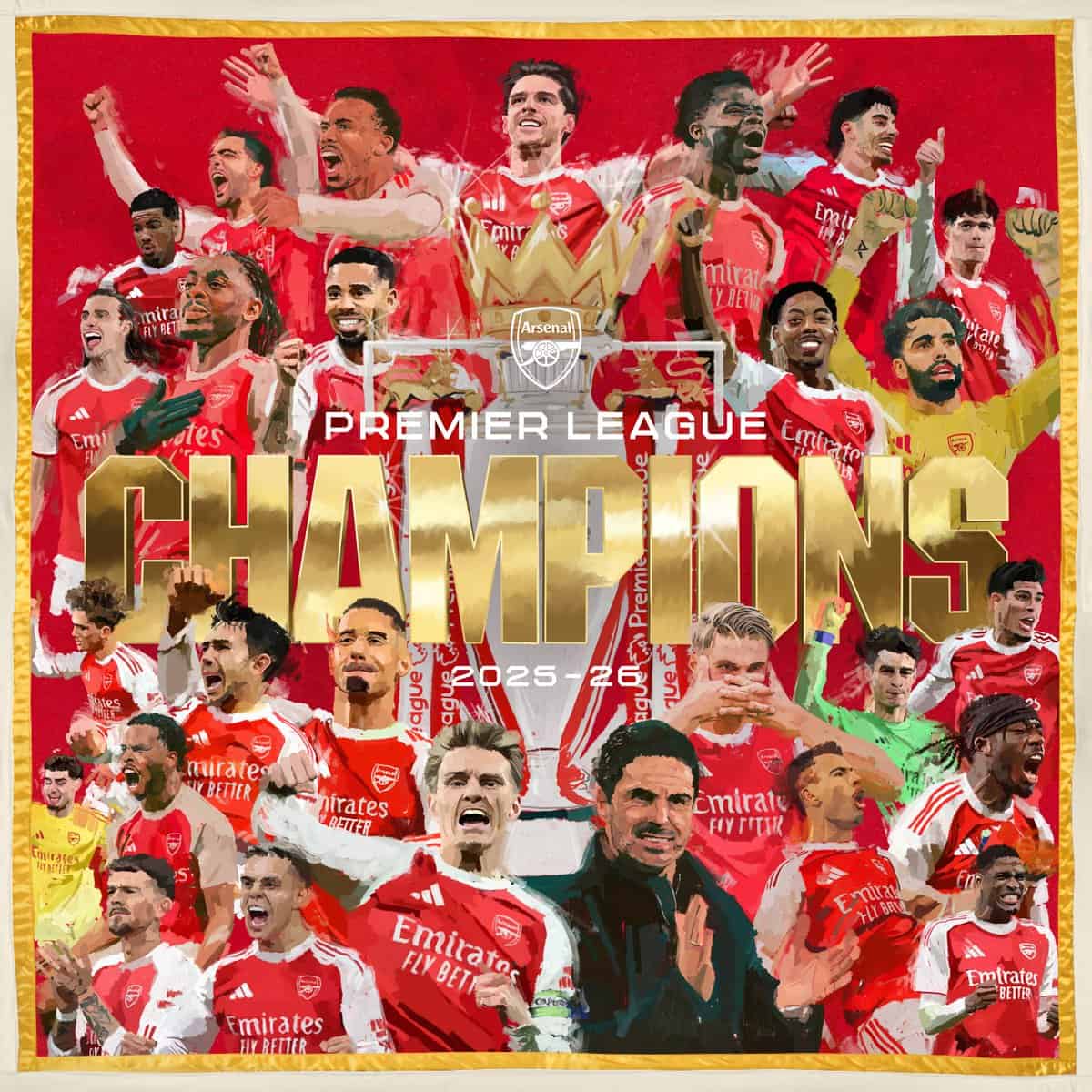
It ended at the Vitality Stadium in Bournemouth, without Arsenal kicking a ball. Manchester City drew 1–1 on Tuesday May 19. Erling Haaland equalizing in stoppage time, too late to matter and Arsenal were confirmed Premier League champions for the first time in 22 years.
Outside the Emirates, supporters who had gathered to watch the City match on screens spilled into the streets. Captain Martin Odegaard posted. Declan Rice posted: “I told you all… it’s done.” Twenty-two years of near-misses, capitulations, and three consecutive runners-up finishes compressed into a single Tuesday night in south-coast England.
In my honest opinion, the manner of it confirmed away from home, watching someone else’s game… was entirely fitting for a title race that had kept Arsenal supporters on the edge of their nerves for four months. The relief was louder than the celebration. Both were earned.
The coronation: Crystal Palace 1–2 Arsenal, May 24
Arsenal ended their Premier League season with a 2–1 victory at Selhurst Park — a result that turned confirmation into silverware in the most fitting way possible. Gabriel Jesus opened the scoring, Noni Madueke added the second, and the travelling contingent of 2,687 Arsenal supporters in the away end witnessed the moment the trophy became real.
Arsenal wore their white third kit for the match, a kit clash with Palace’s red and blue forced the change — then walked back out under the Selhurst Park lights in their red Champions strip for the ceremony. The visual shift from white to red was the clearest possible signal that the football was over and something else was beginning.
Crystal Palace had their own moment first. Departing manager Oliver Glasner received a lap of appreciation from Palace supporters — a generous and unhurried send-off that slightly delayed the Arsenal ceremony. Nobody minded. The wait had already been 22 years; another twenty minutes was nothing.
The standout moment of the evening came before the players emerged. Stan Kroenke and son Josh Kroenke walked out carrying the Premier League trophy, the first time the owners had appeared publicly with the trophy in that way. For supporters who have had a complicated relationship with the Kroenke ownership over the years, the image landed differently depending on who was watching. For the 2,687 in the away end, it didn’t matter. The trophy was there. Arsenal had won it.
Martin Odegaard lifted it last, as he should have. Captain’s hands, captain’s moment. In my honest opinion, that image — Odegaard in red under the south London floodlights, 22 years of waiting compressed into one raised trophy — is the defining photograph of Mikel Arteta’s entire tenure, whatever happens in Budapest.
A victory parade through Islington has been confirmed for Sunday May 31, the day after the Champions League final, regardless of the result against PSG.
How Arsenal won the 2025-26 Premier League title
Arsenal topped the Premier League table for most of the season, but this was not a procession. A 2–1 defeat at Manchester City in April looked like it might hand the initiative back to Pep Guardiola’s side for the fourth time in as many years. For a week, the anxiety that had accompanied every previous title challenge came flooding back.
It didn’t stick this time. Arsenal responded with a 1–0 win over relegated Burnley on the Monday night, then watched City fail to beat Bournemouth 24 hours later. The mathematics were simple: four-point lead, one game remaining, title confirmed.
The season’s record tells the story plainly. 25 wins, 7 draws, 5 losses from 37 games. Viktor Gyökeres finished as top scorer with 12 league goals and 19 in all competitions. The structural foundation of the campaign was set pieces; Arsenal scored 35 goals from set-piece situations across all competitions in 2025-26 — more than any club in Europe’s top five leagues across each of the last ten seasons, according to ESPN.
That last number is the one that reframes the narrative. This wasn’t the fluid, possession-based football of the Wenger years. It was organised, physical, and clinical. In my view, the critics who want Arsenal to win beautifully can have their argument; Arteta’s side won the title, and that conversation belongs somewhere else entirely.
Three runners-up finishes and why this one broke the pattern
Arsenal finished second in the Premier League in 2022-23, 2023-24, and 2024-25. Three consecutive near-misses. Each one had a different shape: one a late collapse, one a City surge, one a final-day failure. Each one produced the same result.
What changed in 2025-26 was not dramatically obvious from the outside. The squad evolved; Gyökeres arrived and provided a finishing threat the previous seasons had lacked in crucial moments. The set-piece work that had been building for two years became the most productive attacking system in European football. The defensive structure, already strong, became genuinely difficult to break down in big matches.
But the difference that supporters will point to most is mental. Mikel Arteta has spoken throughout his tenure about building a team that doesn’t break under pressure; the April defeat at City, and the response to it, was the clearest evidence that this squad had finally internalized something the previous ones hadn’t quite managed.
Three runners-up finishes build pressure; they don’t have to break a team. In my humble opinion, Arsenal’s 2025-26 title is more impressive for coming after those three near-misses than it would have been had it arrived earlier. Winning when the weight of expectation and previous failure is on your back is harder… and it means more.
The parade: Islington, May 31
Arsenal have confirmed a victory parade through Islington on Sunday May 31 — the day after the Champions League final in Budapest. The parade goes ahead regardless of the PSG result.
For supporters who weren’t among the 2,687 in the away end at Selhurst Park, this is the moment the title becomes tangible in their own streets. North London. Red everywhere. Odegaard and the trophy on an open-top bus through the borough the club has called home since 1913.
In my view, May 24 was for the travelling faithful. May 31 is for everyone else. May 30 in Budapest is where history either gets doubled or remains singular.
Budapest: how the Champions League final ended
Arsenal faced PSG at the Puskás Aréna in Budapest on May 30 and came within a single penalty of the double. The match finished 1–1 after 120 minutes of extra time. PSG won the shootout 4–3. Gabriel — who had been magnificent throughout the match — blazed the fifth and final Arsenal penalty over the bar, and PSG retained the Champions League.
The statistics told a sobering story. PSG controlled 75% possession against Arsenal’s 25%. They had 21 shot attempts to Arsenal’s 7. On the night, the better team won; Arsenal’s defensive structure and Raya’s saves kept them in it far longer than the balance of play suggested they should have been.
The shootout itself had everything. Viktor Gyökeres scored Arsenal’s first. Eberechi Eze missed the second. A stuttered run-up that sent his penalty wide of everything. David Raya saved from Nuno Mendes to give Arsenal a lifeline. Declan Rice converted coolly to level the shootout at 3–3. Then Hakimi scored for PSG, and Gabriel stepped up needing to score to keep Arsenal alive… and didn’t. The ball cleared the bar. PSG are back-to-back Champions League champions. The first club since Real Madrid’s three-in-a-row between 2014 and 2017 to retain the trophy.
There were complaints about the referee. Samir Nasri among others felt Arsenal were harshly treated by certain decisions. A Mosquera foul on Kvaratskhelia gave PSG their penalty. Whether the officiating cost Arsenal the match is a conversation that will run through the summer and beyond.
In my honest opinion, Budapest hurt precisely because Arsenal deserved to be there and competed until the very last kick. A penalty shootout loss in a Champions League final after 120 minutes against the best team in Europe isn’t failure. It’s the margin between a historic double and a historic season. That margin was one penalty, one moment, one meter of height on Gabriel’s run-up.
What the 2025-26 season means for Mikel Arteta’s legacy
Arteta took over Arsenal in December 2019, inheriting a club that had finished fifth in two consecutive seasons and had no coherent identity on or off the pitch. He won an FA Cup in his first partial season. Then came the rebuilding years, the academy investment, the recruitment overhaul, and eventually the title challenges that came agonizingly close without breaking through.
The 2025-26 Premier League title is the confirmation that the project was real. Three runners-up finishes are not failure; they are evidence of a sustained competitive rebuild. The title and the Champions League final that followed it are the evidence it worked.
Budapest hurts. It will keep hurting. But it does not diminish what this season was: the first Premier League title in 22 years, a Champions League final appearance for the first time since 2006, and a squad that competed until the last penalty kick against the best team in Europe. That is not a consolation; it is an honest account of an extraordinary season.
In my honest opinion, Arteta’s legacy is already settled regardless of what comes next. He ended Arsenal’s longest title wait since the move to north London… and then took them to within one penalty of a double that the Invincibles themselves never reached. The margin between glory and heartbreak was Gabriel’s penalty. The season was something else entirely.
What 2025-26 leaves behind
Arsenal are Premier League champions for the first time since 2004. They won the title at Selhurst Park on May 24, Gabriel Jesus and Noni Madueke scoring the goals, Martin Odegaard lifting the trophy in south London. Six days later they lost a Champions League final on penalties in Budapest.
Both things are true. Neither cancels the other out.
For a club founded in 1886 by factory workers with a collection tin, a Premier League title and a Champions League final appearance in the same season would have been unimaginable at almost any point in the last two decades. In my honest opinion, the pain of Budapest is real and worth naming… and it sits inside a season that Arsenal supporters will carry with them for a very long time. Not as consolation. As pride.
The parade through Islington on May 31 went ahead regardless. As it should have.
Frequently Asked Questions
When did Arsenal win the 2026 Premier League title?
Arsenal were confirmed as 2025-26 Premier League champions on Tuesday May 19, 2026, when Manchester City drew 1-1 at Bournemouth. The result left Arsenal with a four-point lead and one game remaining, mathematically unassailable. Arsenal had beaten Burnley 1-0 the previous night to set the scene. In my honest opinion, the confirmation coming while Arsenal weren’t even playing was a fittingly nerve-shredding end to what had been a nerve-shredding season.
How many Premier League titles have Arsenal won in total?
Arsenal have won the Premier League and the First Division before it 14 times in total. The titles came in 1930-31, 1932-33, 1933-34, 1934-35, 1937-38, 1947-48, 1952-53, 1970-71, 1988-89, 1990-91, 1997-98, 2001-02, 2003-04, and 2025-26. The 2003-04 season remains the only unbeaten title campaign in Premier League history. The 2025-26 title ended a 22-year gap between the two most recent.
Who was Arsenal’s top scorer in 2025-26?
Viktor Gyökeres finished as Arsenal’s top scorer in 2025-26, with 12 Premier League goals and 19 across all competitions. His arrival provided the finishing threat that had been inconsistent in the previous title-challenging seasons. Beyond individual scoring, Arsenal’s set-piece system produced 35 goals in all competitions across the campaign — more than any club in Europe’s top five leagues in each of the last ten seasons, according to ESPN.
Who are Arsenal playing in the 2026 Champions League final?
Arsenal face PSG in the 2026 Champions League final at the Puskás Aréna in Budapest on Saturday May 30. PSG are the defending Champions League champions and the side that eliminated Arsenal in the semi-finals of the 2024-25 Champions League, 3–1 on aggregate. This is a rematch at the highest possible level, one season on. Arsenal have never won the Champions League in their history. A win would give Arsenal a Premier League and Champions League double in the same season — something the club has never achieved. In my view, regardless of the result, Arsenal’s route to the final — which included a 5–1 aggregate win over Real Madrid is already one of the club’s greatest European runs. The rematch element makes it something else entirely.
When is Arsenal’s trophy presentation?
The Premier League trophy will be presented to Arsenal after their final game of the season against Crystal Palace at Selhurst Park on Sunday May 24, 2026. It will be Arsenal’s first league trophy ceremony since 2004, when Thierry Henry lifted the title after the Invincibles season. In my humble opinion, May 24 belongs to the supporters — the match is a formality; the moment after the whistle is what the last 22 years have been building toward.