
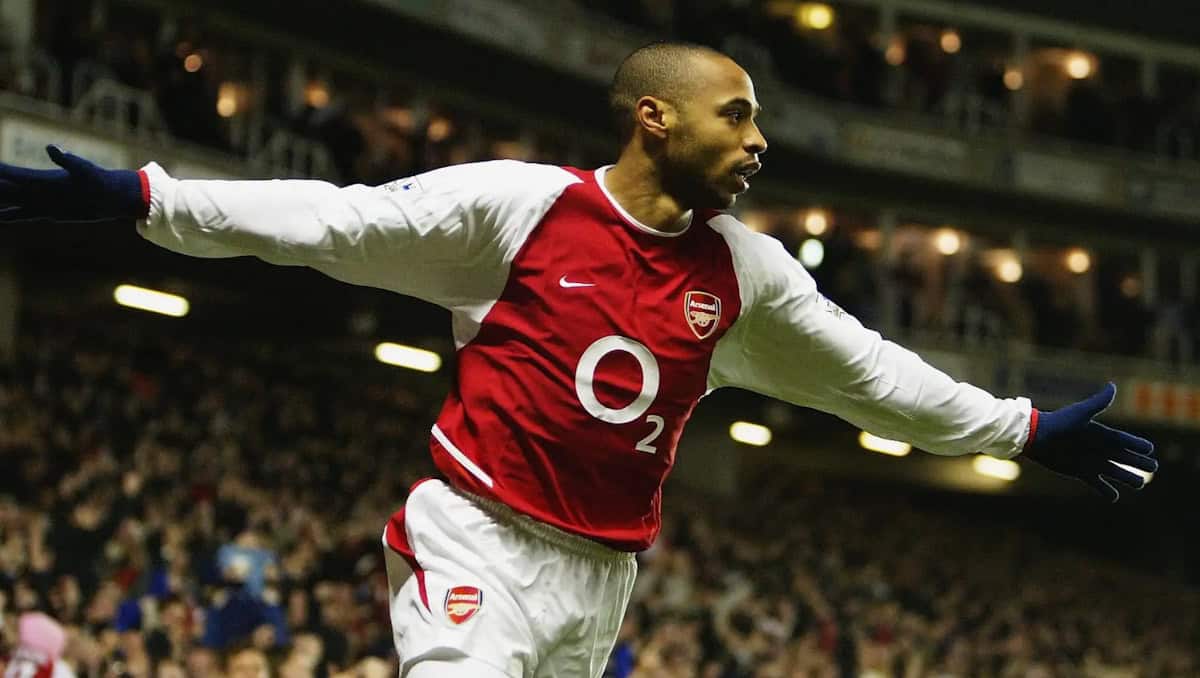
Arsenal’s history has been shaped by a handful of players so specific to their era that the club’s identity is inseparable from them. You can’t talk about the Invincibles without Thierry Henry. You can’t talk about the 1990s without Tony Adams.
You can’t talk about what Arsenal football looked like at its most beautiful without Dennis Bergkamp somewhere in the sentence.
This isn’t a ranked list of the statistically best players in Arsenal history. It’s an account of the individuals who left the deepest marks. The ones who changed how the club played, what the club expected of itself, and what supporters mean when they talk about Arsenal at its best.
In my honest opinion, the players who define a club are rarely the ones with the highest numbers. They’re the ones who captured something about the club’s identity at a specific moment and made it feel permanent.
Thierry Henry: the record, and what it understates
Thierry Henry is Arsenal’s all-time record scorer with 228 goals across two spells at the club. The number is significant; the way those goals arrived is what made him genuinely exceptional rather than just prolific.
Henry joined from Juventus in 1999 as a winger and was reinvented by Arsène Wenger as a centre-forward — or more accurately, as a forward who could play anywhere across the line and score from angles and positions that strikers who stayed central simply couldn’t reach. He would drift left, receive the ball facing his own goal, turn, and finish with a certainty that made it look inevitable even when it wasn’t.
The 2003-04 Invincibles season was Henry at his peak — 30 league goals, the PFA Players’ Player of the Year, the Football Writers’ Player of the Year. He was named in the PFA Team of the Year six consecutive times. In that era, he was the most complete striker in world football; Arsenal happened to have him at his best.
Henry returned for a loan spell in 2012 and scored twice in five appearances, including the winner against Leeds United in the FA Cup. The reception he got at the Emirates told you everything about what he meant. In my view, no Arsenal player in the modern era has been as dominant in their position while wearing the shirt — and that includes players who were extraordinary. Henry was in a different tier.
Dennis Bergkamp: the player who changed what Arsenal could look like
Dennis Bergkamp arrived at Arsenal from Inter Milan in 1995 for £7.5 million and immediately changed the ceiling of what an Arsenal attack could achieve. Before Bergkamp, Arsenal were known as a disciplined, direct, defensively organised side. After him, they were something more technically sophisticated — a team that could build slowly, find the right pass in tight spaces, and produce moments of technical brilliance as a routine expectation rather than a pleasant surprise.
He scored 87 Premier League goals for the club across 315 league appearances — a return that doesn’t capture the full picture, because many of Bergkamp’s most significant contributions were assists, link-up play, and the specific quality of making the players around him better. Patrick Vieira was more dominant in midfield when Bergkamp was ahead of him. Henry was more dangerous when Bergkamp was finding him with passes that bypassed entire defensive structures.
For a full appreciation of how Arsenal’s long history shaped the players it attracted, Bergkamp’s arrival in 1995 is a turning point — the moment the club signalled it could attract and keep world-class technical talent, not just build effective English sides.
The Newcastle goal in 2002 remains the most technically perfect individual moment in Premier League history for many who watched it — a touch to control a long diagonal pass, a second touch to spin 180 degrees away from the defender, a finish before either foot fully planted. It took three touches and less than two seconds. In my humble opinion, it is the single most beautiful goal ever scored in the Premier League, and no amount of time has dimmed it.
Patrick Vieira: the captain the Invincibles were built around
Patrick Vieira captained Arsenal through their most celebrated period and embodied the competitive edge that sat underneath the technical football. He was the player Wenger’s sides needed alongside the creators — dominant in the air, physically imposing, capable of driving the ball forward from deep, and entirely unwilling to be intimidated by anyone on any pitch.
Vieira made 407 appearances for Arsenal between 1996 and 2005, winning three league titles and four FA Cups. The 2005 FA Cup final penalty — the last kick of a shootout against Manchester United, which he put away to win the cup — was his final act in an Arsenal shirt before leaving for Juventus. The timing was almost too perfect.
The Patrick Vieira–Roy Keane rivalry defined an era of English football. Two captains, two temperaments, two clubs competing for the same summit. Their tunnel confrontation at Highbury in 2005 remains one of the most watched clips from that period — not because anything particularly happened, but because the intensity between them was visible without a ball in sight.
In my view, Vieira is the player most responsible for the Invincibles season having the spine it did. Beautiful football without competitive aggression gets picked apart in February. Vieira made sure it didn’t.
Tony Adams: the defender who built the pre-Wenger Arsenal
Tony Adams spent his entire playing career at Arsenal — 669 appearances across 19 seasons, four league titles, three FA Cups, a League Cup, and a Cup Winners’ Cup. He is the definitive one-club Arsenal man; the player whose relationship with the badge was total and unconditional.
Adams captained the side from age 21, becoming the youngest captain in Arsenal’s history at the time. He led the George Graham sides of the late 1980s and early 1990s — the disciplined, organised, defensively-minded teams that won the title in 1988-89 and 1990-91 — and then adapted successfully into the Wenger era, winning a second league and FA Cup double in 1997-98 despite being 31 and playing a fundamentally different style of football than he had been built for.
His public acknowledgement of his struggles with alcoholism in 1996 changed how professional footballers were perceived and discussed in England. It was an act of courage that predated the current culture of athlete mental health openness by decades. In my honest opinion, Adams deserves a dual legacy — extraordinary defender, extraordinary human being — and the second part of that shouldn’t be lost under the weight of the football career.
The current generation: Odegaard, Saka, Rice and Gyökeres
The 2025-26 Premier League-winning squad has its own generation of players already writing themselves into Arsenal history. Four of them stand above the rest.
Martin Odegaard has been Arsenal’s captain and creative engine since inheriting the armband. The Norwegian playmaker arrived on loan in January 2021 and was signed permanently that summer; the signing now looks like one of the most significant pieces of squad-building in the Arteta era. His contribution to the title-winning campaign was not primarily statistical — it was the control and tempo he provided in the moments when the season could have gone either way.
Bukayo Saka came through Arsenal’s academy and established himself as one of the best wide players in world football before his 23rd birthday. His combination of directness, creativity, and defensive work-rate made him the player opponents most needed to stop — and rarely could.
Declan Rice arrived from West Ham for £105 million in 2023, making him one of the most expensive transfers in English football history. The fee looked enormous at the time. Across two seasons, it has looked like value — his presence in midfield gave Arsenal the physical and organisational spine that previous near-miss seasons had occasionally lacked at the critical moment.
Viktor Gyökeres finished the 2025-26 season as Arsenal’s top scorer with 19 goals across all competitions. In my view, his arrival completed the forward line in a way that made the difference between finishing second and finishing first — not through individual brilliance alone, but through the specific kind of reliable finishing the team needed under pressure.
The players who belong in any honest conversation
A famous players list that stops at eight is necessarily incomplete. Several others deserve acknowledgement without shortchanging them.
Ian Wright held Arsenal’s scoring record before Henry broke it in 2005. His 185 goals came with an energy and celebration style that made him one of the most beloved Arsenal players of his era — a player supporters felt personally connected to in a way that pure ability rarely produces on its own.
Robert Pires was the most elegant component of the Invincibles — a left-sided midfielder whose movement and finishing made the system look effortless rather than constructed. Cesc Fàbregas arrived at Arsenal aged 16 from Barcelona’s academy and developed into one of the most creative midfielders in Europe while still a teenager, carrying a diminished squad through several post-Invincibles seasons largely on his own. David Rocastle — Rocky — played for the club in the 1980s and remains one of the most warmly remembered players in Arsenal’s history; his early death in 2001 at age 33 left a gap the club still marks with genuine feeling.
In my honest opinion, the depth of Arsenal’s famous player history is one of the things that separates the club from sides that have won more recently but built less. The names accumulate across generations. Each one adds something the next one inherits.
Frequently Asked Questions
Who is Arsenal’s greatest ever player?
Thierry Henry is the most commonly cited answer — Arsenal’s all-time record scorer with 228 goals, and the central figure of the Invincibles season. Dennis Bergkamp makes a strong counter-argument on the grounds of technical influence and longevity. In my honest opinion, Henry is the correct answer if the question is about peak impact; Bergkamp is the correct answer if the question is about how profoundly a player changed what the club was capable of.
Who has scored the most goals for Arsenal?
Thierry Henry holds the all-time scoring record with 228 goals across two spells at the club. Before Henry broke it in 2005, the record belonged to Ian Wright, who scored 185 goals between 1991 and 1998. Both players’ records were considered untouchable at the time they set them; Henry’s margin over Wright suggests it will take something genuinely exceptional to surpass it.
Who captained the Arsenal Invincibles?
Patrick Vieira captained Arsenal during the 2003-04 Invincibles season. He had been the club’s captain since 2002 and remained so until his departure for Juventus in 2005. Tony Adams had been the previous long-serving captain; the transition between the two marked the shift from the George Graham defensive era to the Wenger possession era in terms of the leadership identity the club projected.
Which Arsenal players are in the current squad?
The 2025-26 Premier League-winning squad is built around Martin Odegaard (captain), Bukayo Saka, Declan Rice, and Viktor Gyökeres, who finished as top scorer with 19 goals across all competitions. Mikel Arteta has managed the squad since December 2019. The current side face PSG in the Champions League final in Budapest on May 30, 2026, with the chance to add a first-ever European title to the Premier League trophy.
Is Dennis Bergkamp in Arsenal’s Hall of Fame?
Dennis Bergkamp is widely considered one of the greatest players in Arsenal’s history. He played for the club from 1995 to 2006, scoring 87 Premier League goals across 315 league appearances, and was part of two league and FA Cup doubles. A statue of Bergkamp stands outside the Emirates Stadium — one of only a small number of Arsenal players to be honoured in that way. In my humble opinion, the statue placement says more about his standing than any award list could.